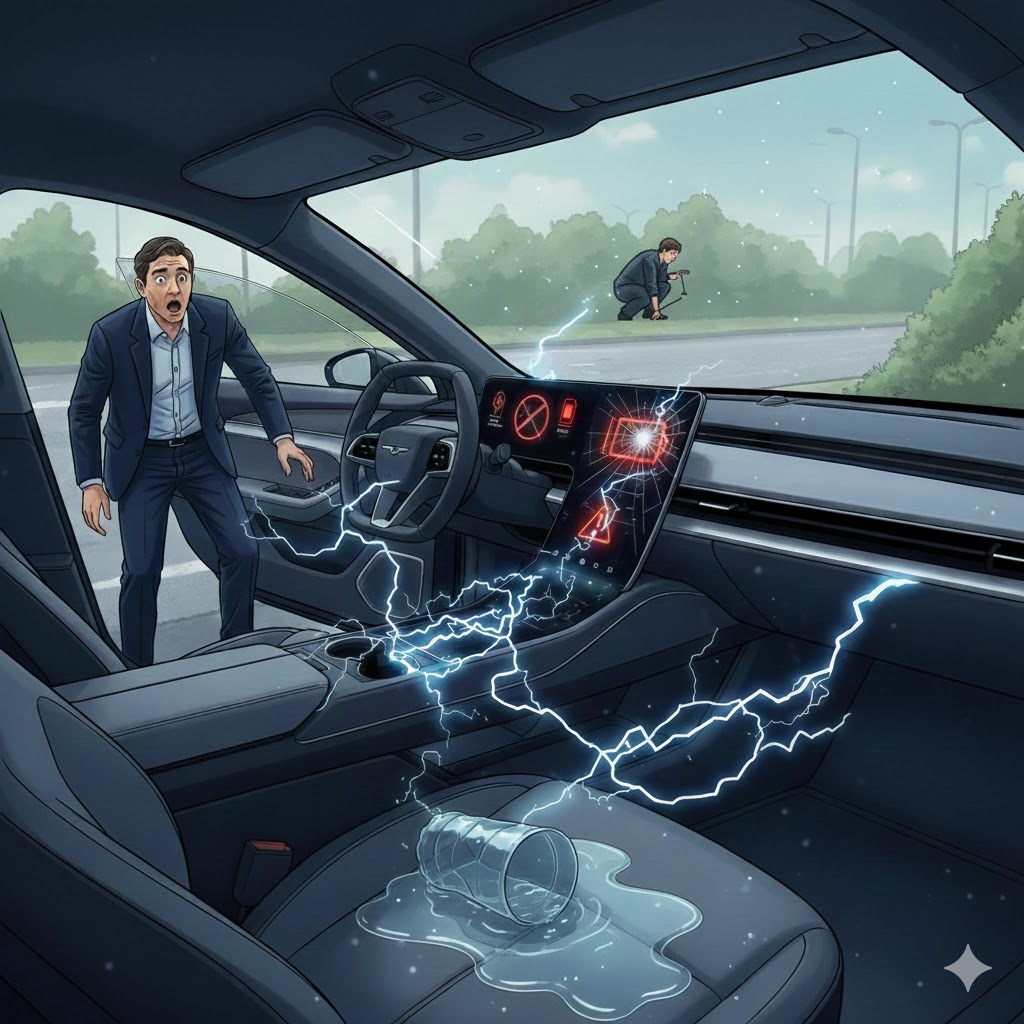
JAKARTA, CNN Indonesia – The ownership of an electric vehicle (EV) often introduces a unique set of challenges and unforeseen expenses, radically different from those associated with traditional combustion engine cars. A recent incident involving a owner of a Lucid Air—an acclaimed luxury electric sedan—has starkly illustrated this financial risk. The owner faced an astronomical repair bill reaching up to US$15,000 (approximately Rp250 million), all stemming from a seemingly minor event: accidentally spilling water inside the cabin.
This alarming episode gained widespread attention after the owner shared their experience on the popular online platform Reddit, detailing how a simple container of water overturned inside the high-tech cabin, swiftly escalating into a five-figure financial catastrophe.
The Sequence of Disaster: From Spill to Shutdown
The incident occurred while the owner was transporting a water container inside the luxurious confines of the Lucid Air. Hitting an unexpected pothole jolted the vehicle, causing the container to tip over and its contents to spill instantly onto the cabin floor and, crucially, onto critical underlying electronics.
The response from the sophisticated vehicle system was immediate and dramatic. The dashboard quickly illuminated with a flurry of warnings, indicating a severe system malfunction. These warnings included:
- The vehicle entering a low-power mode.
- The regenerative braking system being deactivated.
- An urgent system command instructing the driver to pull over immediately.
The core issue lies in the design of modern electric vehicles. While the battery pack itself is heavily shielded and water-tight, the cabin floor often houses crucial, high-voltage control units, communication modules, and wiring harnesses that manage the vehicle’s ancillary functions and integrate the various sensor and control systems. When conductive liquids, such as plain water, infiltrate these components, they can cause short circuits and irreversible electronic damage across the entire digital network of the car.
The Insurance and Warranty Quagmire
The immediate technical failure was quickly compounded by the bureaucratic headache of insurance and warranty claims. Initially, both the insurance provider (Progressive) and Lucid’s own warranty mechanism seemed unwilling to cover the repair costs.
The insurance company argued that the damage did not fall under the typical “comprehensive” category, which usually covers specific events like natural disasters, fire, or theft. Liquid damage, when caused by an internal spillage (as opposed to flooding from an external event), is often classified ambiguously or entirely excluded from standard policies, leaving the policyholder exposed.
Lucid’s warranty stance, though not explicitly detailed, was equally unhelpful. Service centers generally operate under the premise that the warranty covers manufacturing defects. Since the issue was clearly precipitated by an external event—the spilled water—Lucid personnel likely deemed the resulting electronic failure to be a consequence of owner negligence or an external accident, thus invalidating the warranty claim.
Staring down a repair estimate of US$15,000—a sum described by the owner as a “crushing blow,” especially since the vehicle had only been leased for approximately two months—the owner faced the potential of absorbing the entire financial burden himself.
The Technology Paradox: Waterproofing vs. Vulnerability
The severity of the damage raises critical questions about the design and engineering standards applied to electric vehicles. In principle, EV components are extensively designed to be resistant to water ingress, adhering to strict Ingress Protection (IP) ratings. These standards dictate how well enclosures protect sensitive electrical equipment against dust and liquids. For instance, the main battery pack often boasts a rating like IP67, meaning it can withstand immersion in water up to one meter deep for 30 minutes.
However, this high level of protection often does not extend to the entirety of the vehicle’s interior electronics, particularly those placed just beneath the carpet or near the console. The sheer volume of electronics—from control modules for climate control and infotainment to critical communication gateways—means that even a small spill can hit a vulnerable point, causing instantaneous system failure.
The instantaneous and total failure suffered by the Lucid Air is particularly puzzling, suggesting a major control unit was compromised immediately. Without a formal, official diagnostic report or documentation from the manufacturer, it is impossible to determine definitively whether a pre-existing manufacturing fault made the component abnormally vulnerable, or if the water simply landed directly onto a critically exposed connection point. This opacity further complicates the claim process for the average consumer.
The Power of Public Attention and the Insurance Reversal
Several days after the owner shared their predicament, detailing the steep financial estimate and the frustrating bureaucratic hurdles, a crucial turning point arrived. The owner provided an update to the Reddit thread, confirming receipt of an email from their insurance representative. The update delivered the relieving news: the repair costs would be covered in full.
The public nature of the complaint, which garnered significant media attention, likely played a pivotal role in this reversal. The insurance company, Progressive, had reportedly negotiated the cost with Lucid. While the final details involved the owner visiting the shop to settle a small deductible or co-pay, the principal financial burden was lifted. This outcome, though positive for the owner, highlights how the complexity of EV repairs sometimes requires public pressure to navigate the rigid rules of insurance underwriting.
A Growing Industry Trend: The Ioniq 5 Precedent
It is important to understand that this Lucid Air incident is not an isolated anomaly. The vulnerability of complex EV electronics to fluid damage is a recognized, albeit seldom-discussed, risk.
A similar, high-profile case involved a Hyundai Ioniq 5 owner who went viral after facing a repair bill of approximately US$12,000 for liquid damage. In that instance too, the insurance provider eventually intervened and covered the costs only after the issue received widespread media and public scrutiny.
As the adoption of electric vehicles accelerates globally, these types of incidents are likely to become more commonplace. This phenomenon is not necessarily a reflection of poor technology but rather a predictable side effect of real-world use and unexpected accidents. Traditional cars often tolerate spills with minimal consequence; at most, they might damage a simple floor mat or radio unit. In contrast, the modern EV is fundamentally a computer on wheels, where even a small amount of liquid can wreak havoc on interconnected, high-density electronic boards.
The $15,000 spill serves as a powerful cautionary tale for current and prospective EV owners. It underscores the critical need for consumers to meticulously review their insurance policies, understand the often-limited scope of manufacturer warranties concerning external damage, and exercise extreme caution when carrying liquids within the cabin of these technologically advanced, yet electronically vulnerable, vehicles. The price of convenience and cutting-edge technology, it appears, must be weighed against the potential for unexpected, and massively expensive, failures.
Tinggalkan Balasan